

Celebrating Portugal's first ancient DNA laboratory & School collaboration
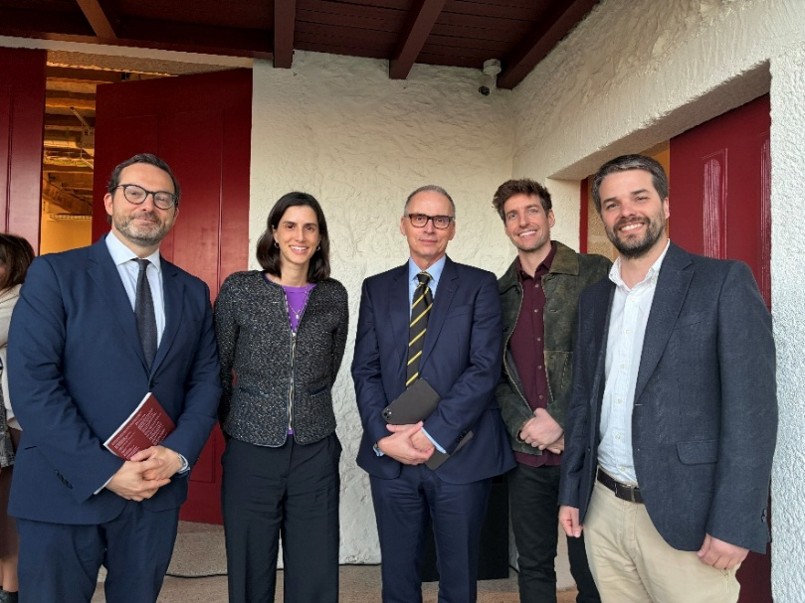
Last week our Head of School, Prof Damian Robinson and Head of Administration and Finance, Victoria Robson had the privilege of representing the School at the inauguration of Portugal’s first national ancient DNA lab at CIBO-BIOPOLIS, the Research Centre in Biodiversity and Genetic Resources at the University of Porto.
Developed in collaboration with the University of Oxford, this collaboration is spearheaded by Dr Joel Alves who divides his time between the Palaeobarn and BIOPOLIS where he is the Scientific Director of the aDNA lab and designed the new state-of-the-art facilities.
The laboratory builds on a long-standing collaboration between BIOPOLIS and the School of Archaeology at the University of Oxford. With the new infrastructure in place, the partners will expand their joint research. An award from the University of Oxford’s John Fell Fund will support an international research network connecting Oxford’s archaeological science with BIOPOLIS’s expertise in biodiversity and conservation and its partnerships across Africa. Through researcher exchanges, workshops and specialist training, the network will develop two pilot projects: one using genetic analysis of seized and historical elephant ivory to trace its provenance and inform conservation strategies to tackle illegal poaching; the other using ancient and environmental DNA to investigate how overfishing and environmental change have shaped biodiversity in Lake Victoria, Uganda.
Professor Robinson said: “Our collaboration brings together two world-class research institutions to ask important questions about our ancient past and how we can work with museum collections, as well as contributing to some of the most pressing issues in the contemporary environment. With the opening of the new BIOPOLIS laboratories, it will be hugely exciting to see what leaps forward in scientific understanding are made as we continue to work together.”
Dr Joel Alves said “Bringing this laboratory to Portugal is a major step for national research capacity. We want it to be a shared resource not just for our researchers but for scientists across the country, enabling them to carry out this kind of research at home. Our goal is for it to grow beyond a facility into a hub for curiosity-driven research that draws scientists from around the world and brings biologists and archaeologists together to connect the past with the present.”
Nuno Ferrand, Director of BIOPOLIS, said: “This laboratory reflects what BIOPOLIS was created to do: bring state-of-the-art research infrastructure, scientific excellence and international collaboration to a place deeply connected to its surroundings. It is a source of great pride that its opening coincides with the Gulbenkian Heritage Prize for the rehabilitation of Quinta de Crasto, where restored historic buildings now host cutting-edge science.”
Over the past two decades, ancient DNA has transformed our understanding of the past, revealing how human populations moved and mixed, how animals and plants were domesticated, and how species responded to human activity and environmental change. The field’s impact was recognised in 2022, when Svante Pääbo received the Nobel Prize in Physiology or Medicine for his pioneering work on ancient DNA. Yet recovering ancient DNA is challenging: it is most often recovered from bones, teeth and other archaeological remains hundreds or thousands of years old, where it is present in tiny, degraded quantities and is highly vulnerable to contamination. Strict contamination control is also important in environmental DNA analysis, where researchers detect species from genetic traces in environmental samples from air, water and soil. The laboratory’s clean rooms, filtered air maintained at positive pressure, full-body protective suits and strict protocols will help limit contamination, maximising the chances of recovering authentic ancient DNA and supporting reliable analysis of environmental samples.
The new laboratory will give researchers at CIBIO-BIOPOLIS, the Research Centre in Biodiversity and Genetic Resources at the University of Porto, dedicated facilities to carry out ancient and environmental DNA analyses in-house, building on research already underway at the centre. Together, these approaches will support research into biodiversity across time and in present-day ecosystems. Through ancient DNA, researchers will investigate the histories of human populations and other species, with a particular focus on the Iberian Peninsula. Museomics, the study of DNA from preserved specimens, will enable researchers to use museum collections as time capsules to study historical biodiversity. Environmental DNA analysis will help researchers detect species and monitor ecosystems through genetic traces left in the environment. The laboratory will also support wildlife forensics, using DNA to identify seized wildlife products and trace their origins. This work will help combat poaching and the illegal wildlife trade, building on BIOPOLIS’s conservation partnerships worldwide, particularly in Africa.