
Environmental Archaeology Stream

The Environmental Archaeology stream explores the role of environmental archaeology in the understanding of past human societies.
Recovery of evidence of biological remains and their soil matrix is nowadays typically a key part of archaeological investigation, both on- and off-site. Critical evaluation of the possibilities and limitations of the evidence recovered is important for the subject to play its full role in the analysis and interpretation of human activity in relationship to the environment.
The history of the discipline is considered as a basis of its development into a core aspect of present-day archaeology. Focus is given to both the methods used to study the interplay between past economies and environments and the theoretical framework that interpretation requires.
Topics covered:
- Preservation & recovery of bio-archaeological material
- Identification & quantification of bio-archaeological material
- Bio-molecular approaches
- Ecology of past societies
- Theoretical issues in environmental archaeology including niche construction and environmental determinism
- Climate change and human activity
- Food production and consumption
- Land use and environmental impacts
The stream combines lectures, tutorials and laboratory based practicals to introduce students to a broad range of bio-archaeological approaches [including: archaeobotany [macro- & micro-], palynology, and archaeozoology]. These general principals are then directly applied through detailed study of plant macro and micro-remains.
The School hosts dedicated laboratories for the recovery, processing, identification, digital recording and isotopic analysis of plant-based materials [charred seed, pollen, phytoliths, starch etc]. There are extensive reference collections of seeds, herbarium and micro-fossil specimens from Europe and Western Asia.
All MSc in Archaeology students take the mandatory Archaeological Principles: Data & Theory. You will also take two core modules offered within Environmental Archaeology: One List A taught in the first term, and the other from List B taught in the second term. The fourth module is your option module (also from List B), also taught in the second term; this is chosen from all available List B modules in any stream, or a module from the MSt in Classical Archaeology. In some circumstances a subject taught in the MSc in Archaeological Science may be taken as your option module, however this is taught over two terms.
Please note that the modules and streams listed on this website are indicative of the typical offerings and are subject to review each year. Whilst every effort is made to offer the full variety of modules/streams this is not possible to do every year. This is due to the fact that some modules/streams are dependent on student numbers to ensure an appropriate quality of education; timetable clashes; staff availability; etc. For enquiries, please email admissions@arch.ox.ac.uk.
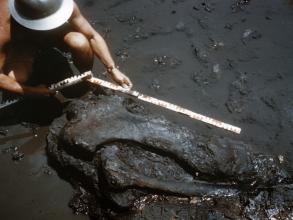
Lectures cover the principles of palaeoenvironmental reconstruction as well as exploring examples of how these data are used in archaeological site investigations, and in documenting broad shifts in past climates and landscapes and human behaviour. Examples are drawn from Old and New World settings. Teaching is based around seminars which consider the methods and theories relating to the discipline and its role within the field of archaeology. These themes are then further explored in the field or laboratory as appropriate.
Convenor: Dr. Mike Charles