

Le Yaudet Project
Directors: Barry Cunliffe and Patrick Galliou
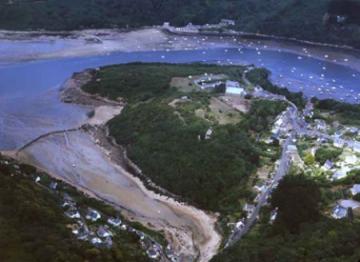
Le Yaudet is a granite promontory guarding the estuary of the river Léguer on the north coast of Brittany. In medieval documents it is known as the ‘old city’ – a memory perhaps of its late Roman fortifications.
Archaeological material, in particular coins, found in the nineteenth century, focused attention on the site and in the 1950s and early 1960s some limited excavations were undertaken.
A new programme of research excavations began in 1991 and continued annually until 2002. The work was a Franco-British collaboration involving the Institute of Archaeology, University of Oxford and the Centre de recherche bretonne et celtique, Université de Bretagne Occidentale and was directed by Barry Cunliffe and Patrick Galliou.
The excavation showed that the promontory had been in use almost continually since the Neolithic period. There is some evidence to suggest that it may have been defended in the Late Bronze Age. In the Late Iron Age a massive rampart (of three structural phases) defended the landward approach with a lesser rampart following the cliff edge.
Occupation continued into the Roman period and in the late third century a masonry wall was built following the line of the earlier rampart. There is little evidence of activity in the first half of the fourth century but by around AD 400 the site was again in active use and has been occupied ever since. The excavation produced extensive evidence of settlement and agricultural activities from the fifth to eleventh centuries and of village development thereafter.Several of the houses still inhabited date from the sixteenth century when there was extensive rebuilding in stone.
Le Yaudet today is a living village clustered around a chapel. The rest of the headland belongs to the Commune and is managed as a cultural and natural history resource. It is a place of great beauty and tranquillity with incomparable views of the sea and the Léguer valley.
There is little to see of its distant past but the main Iron Age rampart is an impressive structure and parts of the Roman wall survive particularly at the north-east corner. The chapel was largely rebuilt in the mid-nineteenth century but the houses which cluster around it are much older some dating back to the sixteenth century. One intriguing feature is the Mur de Pêcherie – a massive wall cutting off the narrow inlet to the west. It almost certainly represents a barrage to support one or more tidal mills and dates to the early medieval period.